The Crystal ingredient library
Gold and colloidal gold
Elemental gold
Discover gold, its history and colloidal form, and how it appears in our 40 PPM liquid and rich botanical face cream.

Gold at a glance
- ElementGold
- Chemical symbolAu
- Atomic number79
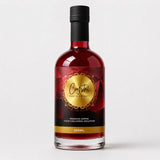
- Our liquidColloidal Gold, labelled 40 PPM
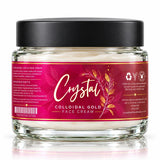
- Our skincareColloidal Gold Face Cream
- Ingredient familyMinerals & colloids
Meet the element gold
Gold is a soft, yellow metallic element that has been worked into jewellery, decorative objects and fine leaf for thousands of years. It can occur naturally as metal, including in veins and deposits carried by water. Its lasting colour and ability to be shaped into thin sheets help explain its long association with precious objects.
In alchemical imagery, gold has also been linked with the sun. That symbolism is part of its cultural history, distinct from the properties of a finished preparation. In our ingredient library, the starting point is the material itself: gold, identified by the chemical symbol Au.
What is colloidal gold?
Colloidal gold is a preparation containing very small gold particles dispersed through a surrounding medium. Our liquid product describes elemental gold dispersed in purified water. “Colloidal” refers to the physical form of that dispersion.
The term does not, on its own, tell you how much gold is present, the measured particle-size range or the intended use of a finished product. These details belong to the individual formulation and its specification. That is why reading the complete product information is more useful than comparing ingredient names alone.
Gold, colour and light
Gold in a colloidal preparation can look very different from a piece of yellow metal. A famous example comes from Michael Faraday’s work at the Royal Institution in the 1850s. While investigating thin gold films, he noticed ruby-coloured liquid containing extremely small suspended particles.
Faraday explored how those particles interacted with light. His surviving bottles offer a fascinating connection between a familiar precious metal and the much smaller scale of a colloidal dispersion.
For a customer, the practical point is simple: appearance is only one feature of a liquid. A colour does not establish its concentration, composition or quality, and a historic laboratory sample does not establish the properties of a modern retail formula.

Understanding the 40 PPM label
PPM means parts per million. Our Colloidal Gold liquid is currently labelled 40 PPM and supplied as a 500ml bottle. These figures describe different things: PPM is the stated concentration, while millilitres describe the quantity of liquid in the bottle.
- Concentration: how much of a substance is present in a preparation.
- Volume: how much liquid the container holds.
- Particle size: a separate characteristic that requires its own measurement.
A PPM figure is not a rating of therapeutic benefit. It also does not establish the concentration in another product that uses colloidal gold as one ingredient. Our face cream has its own formula and should be read as a separate product.
Gold in our range
Two distinct formulas bring gold into the Crystal Health & Beauty range.
Liquid colloid
Colloidal Gold 40 PPM
A 500ml liquid preparation listing purified water and elemental gold, supplied in amber glass. The current listing states no artificial colours, flavourings or sweeteners.
Explore Colloidal Gold
Facial care
Colloidal Gold Face Cream
A rich facial moisturiser combining colloidal gold with botanical oils, plant butters and vitamin E. Neroli and frankincense give the cream its floral and resinous aroma. For external use only.
Explore Gold Face CreamVisit each product for its complete ingredients, directions and current availability.
The botanicals alongside gold
In the face cream, gold is the signature ingredient named on the jar, while the botanical base creates its rich, conditioning feel. Discover jojoba for its liquid-wax character and meadowfoam seed oil for its smooth cosmetic texture.
Rosehip oil and murumuru butter offer further ways to explore the blend. Understanding these ingredients together gives a fuller picture of the cream than looking at gold in isolation.
Keep the cream cool and away from direct sunlight. Its natural butters can soften with warmth. Use clean fingertips, begin with a small amount and stop using it if irritation occurs.
Common questions about gold
What does 40 PPM mean in colloidal gold?
PPM means parts per million. Our liquid is labelled 40 PPM, describing its stated gold concentration. This is separate from the 500ml bottle volume, the purity of a starting material and the size of the particles.
Is the face cream also 40 PPM?
The 40 PPM description belongs to our Colloidal Gold liquid. The face cream is a separate finished formula, and its listing does not specify a final gold concentration. The liquid’s concentration should not be transferred to the cream.
Is colloidal gold the same as gold leaf?
No. Gold leaf is metal formed into very thin sheets. Colloidal gold describes tiny gold particles dispersed through a medium such as water. The ingredient’s physical form matters, even when the same element is involved.
What gives the Gold Face Cream its rich feel?
Its botanical oils and plant butters form the moisturising base. Jojoba, meadowfoam, rosehip and black seed oils sit alongside the richer butters, while neroli and frankincense provide the aromatic finish. The texture comes from the complete blend.
Can colour tell me whether a colloid is good quality?
Colour alone cannot establish concentration, particle size, purity or suitability. If you have a question about a particular bottle, keep its label and batch details and contact us. A photograph cannot replace product-specific analysis.
Keep exploring
Browse minerals and colloids, compare the separate entries for silver and copper, or return to the complete ingredient library.
Background references: Royal Society of Chemistry: gold, IUPAC: colloidal dispersion and Royal Institution: Faraday’s gold colloids. These explain the element and terminology; they are not tests of, or endorsements for, CHB formulas.
The same colloidal gold solution is used in our Colloidal Gold and Jasmine Soap. That 60 PPM figure describes the solution used to make the bar, not a measured amount of gold in the finished soap.
For complete ingredients, allergens, suitability and directions, read the current product label. A guide to one ingredient does not describe every possible effect of the finished preparation.
