
The Crystal ingredient library
Celtic sea salt
Coarse Sel de Guérande
Discover coarse grey sea salt from Guérande: its traditional harvest, naturally moist texture and place in the kitchen and our bath blends.


What is Celtic sea salt?
Celtic sea salt brings a distinctive texture to the kitchen: coarse, slightly damp crystals with a soft grey colour. Our salt comes from the Atlantic salt marshes of Guérande in France, where seawater, sunshine, wind and traditional harvesting methods shape the finished ingredient.
You may also see this style described as sel gris, meaning grey salt, or gros sel, meaning coarse salt. These names help describe its appearance and grain size. When choosing a salt, check the origin and processing information for the particular product rather than assuming every salt sold under a similar name is identical.
- Origin of our saltGuérande, France
- TextureCoarse, naturally moist crystals
- Main componentSodium chloride
- Everyday roleSeasoning and culinary preparation
From salt marsh to kitchen
In Guérande, seawater is channelled through shallow ponds. As water evaporates in suitable weather, the brine becomes concentrated and salt crystals form. Salt workers gather the coarse salt by hand using long-handled tools.
The grey character is associated with the clay-lined ponds where coarse salt crystallises. Fleur de sel is different: its delicate crystals are gathered from the surface. Neither name describes a recipe or a seasoning blend; they refer to distinct forms of sea salt.
Our coarse salt is supplied unrefined, without added anti-caking agents. Its character is therefore different from a uniformly dry, fine table salt. The product page gives the details of the salt currently in our range.

Understanding the crystals and mineral content
The first thing you may notice on opening the bag is that the crystals feel slightly damp. They may gather into soft clumps rather than pouring like dry table salt. This is a normal feature of moist grey sea salt, not a reason to expect perfectly separate grains.
Coarse crystals also behave differently in a recipe. They take longer to dissolve than finely ground salt, and a spoonful can contain a different weight depending on crystal size and how closely the grains pack together. For recipes that specify an exact salt amount, weighing is more consistent than swapping spoon measures.
Celtic sea salt is principally sodium chloride, with smaller amounts of other minerals. Those trace amounts are part of its composition, but do not make a normal culinary serving a complete mineral supplement. Unfortified sea salt is not a dependable source of iodine. Explore our iodine ingredient guide if you would like to understand that separate ingredient.
How to use coarse Celtic sea salt
Think about the texture you want in the finished dish. Dissolving the crystals gives even seasoning throughout a liquid; grinding them gives you more control when seasoning at the table.
- Soups, sauces and cooking water: add a small amount, allow it to dissolve, then taste before adding more.
- Roasted vegetables: crush the crystals if you prefer a finer, more evenly distributed seasoning.
- Finishing dishes: use sparingly where a little crystal texture suits the food.
- Brining and fermentation: follow a reliable recipe and weigh the salt accurately. Do not assume a coarse spoonful is equivalent to the same spoonful of fine salt.
For grinding, choose a mill designed for moist sea salt and follow the manufacturer's guidance. A pestle and mortar offers a simple alternative for preparing a small amount. The appeal here is flavour, texture and traditional production: use it as a seasoning, rather than adding large amounts to a daily routine.
Celtic sea salt in our range
You will find this ingredient in three different places in our range. The format matters: food salt and a scented bath blend have different intended uses.
Kitchen ingredient
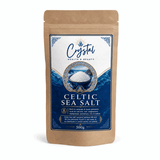
Organic Coarse Celtic Sea Salt 500g
Our standalone coarse grey salt, supplied in a resealable bag for seasoning and culinary use. Read the product page for its origin, processing details and typical composition.
Explore the coarse sea salt →
Bundle containing food salt
Complete Iodine Companion Bundle
This selection includes the 500g Celtic sea salt alongside iodine and other products. Each item has its own purpose and directions; the salt remains a culinary ingredient.
See the bundle contents →
Bath ritual · external use only
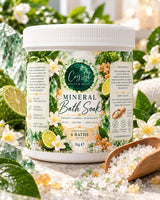
Mineral Bath Soak
A blend with Celtic sea salt, Epsom salt, sodium bicarbonate, bentonite and bergamot, jasmine and frankincense aromatic ingredients. Follow the finished product's directions. This scented bath blend is not food.
Explore the mineral bath soak →Epsom salt and sea salt are different ingredients: Epsom salt is magnesium sulfate, while sea salt is mainly sodium chloride. Read the full label when comparing blends.
Storing and handling your salt
Reseal the bag after use and keep it away from splashes, strong odours and kitchen steam. Use a clean, dry spoon so you do not introduce food residue or extra water into the bag. If transferring it to a container, choose a clean food-safe jar with a well-fitting lid and retain the original product information.
Some clumping is expected with naturally moist salt; gently break it apart as needed. Follow the pack's storage guidance. Keep food salt separate from bath products, especially if you decant them into similar jars.
Celtic sea salt questions answered
What is Celtic sea salt?
Celtic sea salt is a name commonly used for traditionally harvested grey sea salt. Our coarse salt comes from Guérande in France and has naturally moist crystals.
Why is the salt grey and damp?
The grey colour is associated with the clay-lined salt ponds where the crystals form. A moist texture and some clumping are normal characteristics of this style of unrefined salt.
Is Celtic sea salt the same as fleur de sel?
No. Coarse grey salt forms at the bottom of the salt pan, while fleur de sel is collected from the surface. They differ in crystal texture and how they are commonly used in cooking.
Can I put it in a salt grinder?
Use a grinder specifically suitable for moist sea salt. Damp crystals can clog mills intended for dry salt. A pestle and mortar is another option when you want a finer texture.
Does Celtic sea salt provide iodine?
Unfortified sea salt is not a dependable iodine source. Celtic sea salt is principally sodium chloride; its trace minerals do not make it a complete mineral supplement.
Is the mineral bath soak suitable for cooking?
No. Our Mineral Bath Soak is a finished bath blend containing Celtic sea salt alongside other ingredients, including essential oils. It is for external use only. Choose the separate food salt for culinary use.
Keep exploring the ingredients
Discover how different ingredients fit into our range in the Learn ingredient library, or read about magnesium and iodine.
For background on traditional harvesting, see Le Guérandais' explanation of coarse salt and fleur de sel. This explains the regional process; it is not a certification statement for our particular product.
For complete ingredients, allergens, suitability and directions, read the current product label. A guide to one ingredient does not describe every possible effect of the finished preparation.
