
The Crystal ingredient library
Steam-distilled water
Base for mineral liquids
Discover how steam-distilled water is prepared and how this liquid base fits into the ingredients and specifications of our range.

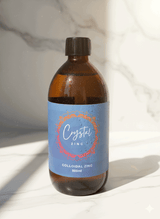
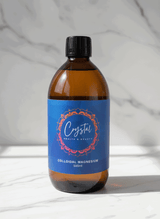
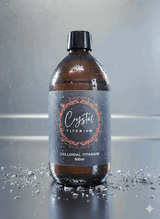
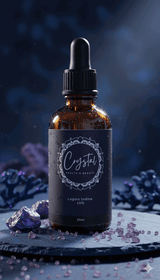
What is steam-distilled water?
Steam-distilled water is prepared by heating water, collecting the vapour and cooling it back into liquid. The cooled liquid is collected separately from the starting water. Many dissolved substances remain behind during that separation.
The key is not simply the heat. Boiling a kettle does not produce a separate bottle of distilled water: the vapour has to be captured and condensed. This is the basic distinction between boiled water and water prepared by distillation.
- Starting pointLiquid water
- Heating stageWater becomes vapour
- Cooling stageVapour condenses to liquid
- In a formulaThe prepared liquid base
The role of water in a formula
Water can be the largest part of a liquid product even when another ingredient gives that product its name. In a simple mineral liquid, it provides the base in which the named material is present. Reading that base ingredient is part of understanding the full bottle.
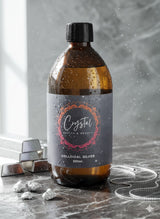
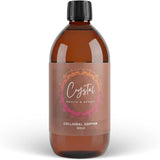
Our original Colloidal Silver lists silver and steam-distilled water. Colloidal Copper also names steam-distilled water as its base. Those descriptions explain the composition; they do not mean the two liquids are the same product.
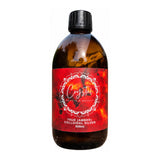
Other formulas include additional ingredients. True Colloidal Silver describes a production process using cinnamon bark extract, while Lugol’s Iodine names elemental iodine and potassium iodide alongside the water. A shared base can therefore appear in quite different preparations.

Where it appears in our range
The following individual product listings explicitly name steam-distilled water. Follow each link for its full ingredients, format and current directions.
- Colloidal Silver
- True Colloidal Silver
- Colloidal Copper
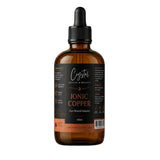
- Ionic Copper
- Colloidal Zinc
- Colloidal Magnesium
- Colloidal Titanium
- Lugol’s Iodine
- Colloidal Silver Atomiser
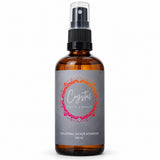
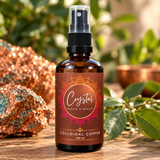
- Colloidal Copper Atomiser
Some other listings use the broader wording “purified water” or simply “distilled water”. We have kept the links above specific to products that name steam-distilled water, rather than assuming that every description refers to the same specification.
A product sold as part of a bundle retains its own formula. Read the information for each bottle in a set rather than treating the bundle as a single liquid preparation.
Water type, concentration and volume
Three different details often appear together on a liquid-product label: what the base is, how concentrated the preparation is and how much the bottle contains. They answer different questions and should be read separately.
- Water type describes the base named in the ingredients.
- PPM or percentage describes a concentration or stated strength, according to that product’s specification.
- Millilitres describe a volume, such as the amount of liquid in the bottle.
A raw-material purity figure is another separate detail. For example, a percentage describing the metal used to make a product is not automatically the percentage of that metal in the finished liquid.
When comparing two bottles, begin with the full ingredient list, then check the concentration and volume. That gives a clearer comparison than relying on a product name or a single large number on the front.
One base, different finished products
A pouring bottle and an atomiser can look very different even when their descriptions name similar ingredients. The dispensing format is one part of the product information. It does not, by itself, establish that all application methods are suitable.
Likewise, the presence of distilled water does not mean a finished product should be handled like ordinary drinking water. Its other ingredients and directions still matter. Use the individual product information when deciding how it is intended to be used.
To explore the ingredients alongside the water, see our guides to silver, copper and iodine. For another perspective on liquid formulas, our vegetable glycerine guide explains a different formulation ingredient.
Handling and storage
Keep the original label with the bottle and follow its storage directions. Close the container after use and avoid pouring unused liquid back into it. The water base alone is not a reason to dilute, combine or refill a prepared product.
Adding water changes the concentration of what is already in the bottle. It can also change the conditions in which the formula is stored. Unless the product’s own directions explicitly call for dilution, use the preparation as supplied.
Different products may have different temperature requirements. Several of our colloidal listings advise keeping bottles away from direct sunlight and not refrigerating or freezing them. Check your particular label rather than applying one storage rule to every liquid in the range.
Steam-distilled water: your questions answered
What is steam-distilled water?
It is water collected after heating produces vapour and cooling turns that vapour back into liquid. This separates the collected water from many dissolved substances in the starting water.
Is boiling water the same as distilling it?
No. Distillation includes collecting and condensing the vapour separately. Simply boiling water and leaving it in the same vessel does not complete that separation.
Why does water appear on a mineral-liquid ingredient list?
Water forms the liquid base. The complete formula also identifies the mineral or other ingredients, which determine what is in the finished product.
Does steam-distilled water tell me a product’s strength?
No. Water type describes the base. A stated PPM or percentage describes a different part of the specification, while millilitres describe volume.
Are all products with this water base interchangeable?
No. They can contain different ingredients, have different strengths and come in different formats. Read the individual product information and directions.
Should I top up a finished product with water?
Use it as supplied unless its own instructions explicitly direct otherwise. Adding water changes the concentration and can affect the finished preparation.
Further reading
For an explanation of evaporation, condensation and distillation, see the USGS Water Science School. Continue exploring our formulation ingredient guides.
For complete ingredients, allergens, suitability and directions, read the current product label. A guide to one ingredient does not describe every possible effect of the finished preparation.
